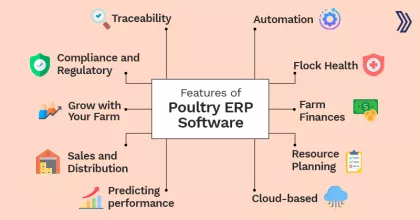
If you are researching poultry management software, you must have figured out that the problem isn't a shortage of options, in fact there are plenty of poultry software options available, and most of them are having the same functionality. Most software available in the market promises to revolve around common terminology which is "real time data" , "streamlined operations" , "complete visibility" and others.
None of that tells you whether the software will actually fit how your farm, hatchery, or feed mill runs. This detailed blog will help you understand what actually matters when you're comparing different software.
Understanding your Requirements
Selecting any software should not be based on features offered, the decision must be on the requirement. To find out your requirements, write down what you actually need. Your need can be a breeder farms module or hatcheries module or broiler sheds module or layer houses module or may be a feed mill or combination of few. Poultry operations rarely need the same software twice, because the data that matters changes by each stage and stage wise bifurcation must be done.
- A hatchery module takes care about fertility rates, hatch percentage, and breakout analysis.
- A broiler farm module lives and dies by feed conversion ratio (FCR) and mortality trends.
- A feed mill module needs formulation and raw material costing.
- A layer farm module operation tracks egg production curves and grading.
- If you're an integrator running a contract-grower model, you need a completely different layer of software on top of all of this — but that's a big enough topic to talk about the same separately.
You must not ask "what can this software do", rather than this question you should start with asking yourself - "What do I need to see/monitor every single day to run my operation better in comparison to last month". Make a list and then check which vendor are actually offering as per your requirements.
Core Features that must be Non-Negotiable
There are few mandatory module which must be present in the software regardless of its scale of operation and which differentiate purpose-built poultry software from generic farm management tools.
1. Batch and Flock Tracking
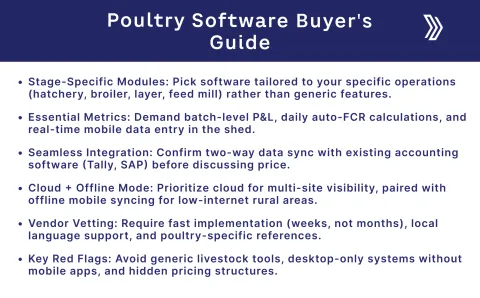
The software must track every bird group from the time of placement to its exit – This will include mortality, feed consumed, weight gain, medication and vaccination schedules. These records must be tied to a single batch which you can be retrieved in seconds.
2. Automatic FCR and Performance Calculation
If your calculation of feed conversion ratio is based on the calculation done by hand or in a separate spreadsheet that is updated once a week, then your decisions might go the wrong track because the foundation of the decision is weak information. On the other hand the software calculate it daily, automatically, from the data your team is already entering.
3. Health and Mortality Logging
This is actually data captured in the field. A software or the system that works from an office desktop will not be used consistently in real time. Your supervisors and farm staff need to log detain in real time for mortality, symptoms, and treatments from a mobile phone, standing in the shed - not from memory after returning from the field on a computer.
Financial tracking must be done at the batch level, not just on the farm level. This is where many software lacks. Knowing that your farm made a profit this month or this quarter is important but in addition to this analyzing which specific batches were profitable and why, is also valuable. Profit and loss must be understood at each level rather than at the firm level. Profit and loss must be shown at Feed cost, chick cost, medication, labor, and sales so as to understand the loop hole.
Ask About Integration Before You Ask About Price
In the software demo discussion, firm owners at times unknowingly skip the question related to the older system. Which must be framed as “will this software talk/integrate to the process which is already being used?”
Most mid-sized and large poultry operations run accounting software — Tally is extremely common across India and the Middle East, and larger groups often run SAP or another ERP for finance. The newly installed poultry software system must be able to exchange (load / upload) data from your existing accounting system. if it is not, in that case you end up with two data sources. Every month you will be required to manually re-entering numbers. This will be a major inconvenience; it's exactly the kind of friction that gets a new system abandoned within a year.
Ask vendors directly: can this export to or integrate with Tally or SAP? Does it have an API? Can it connect to weighing scales, feed mill controllers, or other hardware you already have on-site? If the answer is vague, treat that as a real warning sign, not a detail to sort out later.
Cloud vs On-Premise — Why the Answer to this is Shifting
In the earlier decade, many poultry operations in India and Middle East was primarily on-premise software, this was largely due to reliability concerns over internet in rural locations. That calculus has changed. Cloud-based systems now handle poor connectivity far better than they used to — most capture data locally on a device and sync once a connection is available — while giving owners and management the thing on-premise systems can't: access from anywhere, including a phone, when you're not physically at the farm.
If you operate a single site and almost never travel, on-premise software are still better option. For anything beyond that, which includes multiple farms, traveling owners, or plan to expand , will categories in cloud software as a practical default case, and you are confused between Cloud vs On-Premise , then remember this - Cloud software are not in trend they are just required.
If you operate multiple sites, you don’t have better option
Multi-site operations and Profit consolidations are very different from single firm operations. Few question which must be asked for multi-site operation are:
- Can I see consolidated financials across all my farms in one view, while still drilling into any single farm's numbers?
- Does the system handle different currencies if you operate across countries?
- Can regional managers' access be limited to see only their own sites, while ownership is able to view everything?
A lot of software handles this poorly, if a software was built for one farm and multi-site support was added afterward. You can easily spot this by asking for a live demo of the consolidated view, not just the single-farm dashboard.
A Short Vendor Checklist
Get these following answered before you sign anything, this will assist in deciding better:
1. Implementation time
Implementation must be completed in Weeks, not in months. This is reasonable for most poultry ERP systems. If a vendor quotes six months implementation time or more, simply ask “why”?
2. Training and support
You must know who are the trainer for your farm staff for software implementation, and in which language they will train the staff . Is their support available during farm running hours or just typical office hours?
3. Data ownership and export
You must confirm whether you can export your own data in a usable format in case you ever decide to switch systems? If a vendor is not giving any clear answer to this query, it’s worth noting down.
4. Pricing Transparency
You must ask that Is the pricing per farm, per module, or per user? Are there any setup fees or any hidden charges which are not mentioned upfront. Take all the details so that there are no hidden things coming up after buying
5. References from Poultry Operations
Not just "agriculture" clients. A system that works well for a dairy or crop farm tells you nothing about how it handles hatchery breakout analysis.
Red Flags Signals Worth Watching
There are few patterns that are worth treating as deal-breakers rather than minor concerns: software that was originally built for general farm or livestock management and later marketed to poultry, with no poultry-specific metrics like FCR or hatchability built in; no mobile app, or a mobile app that requires constant internet connectivity with no offline mode; and demos that only ever show clean, pre-loaded sample data rather than letting you see how the system handles messy, real-world entries.
Don’t settle for poultry software built on sanitized demos—test it against your toughest daily numbers. Bring your messiest spreadsheet to a live Livine demo and see how true batch-level clarity transforms your operation.