If you've started shopping for poultry management software, you have likely asked this question soon : should you go with a cloud-based system, or install something on your own servers?
This is not a decision. Make a mistake. You are either paying for hardware you don't need or you have given your flock data to a system that can't manage a power outage during the busiest peak hatching season. So let's walk through what actually separates the two, and — more usefully — which one fits your kind of operation.
What does "Cloud" and "On-Premise" actually mean?
An on-premise poultry ERP is operated on a server in a room somewhere on your company's premises (or possibly hosted by a third-party, but installed on servers you own).
A cloud poultry ERP is operated on the infrastructure of a vendor you purchase it from.
Neither is objectively better: it depends on the size and organization of your operations, the level of sophistication of your in-house IT, and other factors.
Where cloud poultry ERP wins?
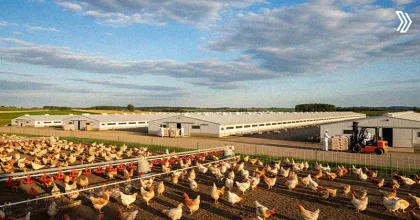
- More flexibility: you're unlikely to run a poultry operation from a single farm, with a single building even. You might have a breeder farm, a hatchery, several broiler sheds, and potentially other facilities like a feed mill or a processing plant, and these may be spread out in a single municipality or across multiple regions. Having a cloud ERP enables farm supervisors at any of these locations and your finance team at the main office to see the same information without having to dig through emails or set up vpn connections. If you manage multiple facilities, this often ends up being a deciding factor.
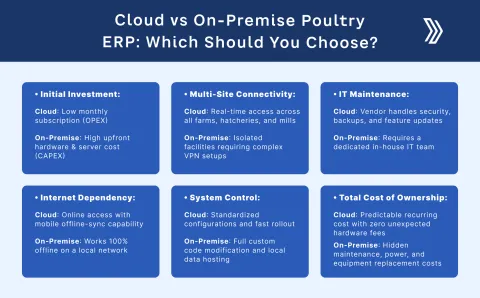
- A Smaller Initial Investment: To set up an on-premise poultry ERP with sufficient servers and a secure physical location requires purchasing servers, renting or purchasing a server room (with utilities), and potentially even hiring IT staff to maintain the system and ensure regular backups. Cloud ERP solutions generally use a subscription-based business model, meaning there's no large initial investment.
- Someone else handles outages and security: Your poultry data needs to be available everyday, especially during a disease outbreak or a recall: it's not ideal to have the software down at the worst possible time. Cloud providers have redundancies in place and regular security updates, and deal with the headaches that arise from having an application always available across a distributed network of users. Those headaches are now theirs to deal with, and you can focus on more important things than making sure your backup generators can handle a hurricane
. - It's much faster to set up and receive support for: Setting up an on-premise ERP can take weeks due to the technical complexity of such a system. Cloud ERP solutions generally take days or even hours to stand up.
- It has automatic updates: When your vendor releases a new feature, or an update to their AI mortality prediction engine, you simply see it appear in your instance of the software. There's no need to schedule and perform a software update, especially since there's a good chance your in-house IT doesn't fully understand how the software works.
Where on-premise still makes sense?
It is not always the superior option, however. There are some cases where a cloud solution is less desirable, and an on-premise poultry ERP is still a viable choice:
- Very limited or unreliable internet access - If the poultry operation is in an area that doesn't have reliable internet access, or is completely cut off from it, a cloud solution is not a good idea. Having data about your birds only accessible over an unreliable link can prove to be more liability than anything else, especially if you're trying to ensure feed is delivered during an outage.
- Legal or regulatory requirement - There may be regulations that require data about your business operations to be stored in specific locations. This may apply to multinational corporations that have to store data in the country where it is generated, or in another country for legal reasons. This can also apply to on-premise solutions if there's a requirement that the data be housed on company owned servers.
- You already have the infrastructure and resources: If you're an established large scale poultry company with existing IT systems, running an on-premise ERP may well be the cheapest way of continuing operations. The cost of an enterprise subscription for a cloud ERP may outweigh the costs of maintaining a server for housekeeping tasks such as backups and updates.
- You need maximum control and customization: Very large companies sometimes want to modify the underlying code of an ERP solution, and may not want to be limited by what a third party develops. You'll be entirely responsible for updates and maintenance, but you'll also have full control over how your software is customized to work with your existing equipment.
What matters is what your operations need
The real question: what does your operation actually need?
Here's a simple way to think about it, based on how most poultry businesses are actually structured:
- Single Farm with few employees: Cloud almost exclusively wins out, as there's no one to maintain an on-premise server. You get enterprise level tools without having to add the cost of an IT person to maintain them.
- Multiple Farms and facilities: Cloud wins hands down as it allows for the necessary management and oversight of any large scale agricultural operation. In fact, there's a decent argument to be made that without a cloud ERP, such an operation simply can't be done.
- Unreliable Internet: Look into cloud providers with mobile apps that allow for offline data entry and syncing when possible. This removes the single largest liability of a cloud ERP while also retaining the advantages.
- Legal Requirements: Ask your cloud vendor if they offer hosting in a region that meets your legal requirements.
- Large Scale Operations with existing resources: It's worth considering, but you should look at the long term costs and savings. It may be cheaper to maintain the infrastructure for an on-premise ERP than to pay for a subscription indefinitely.
Cost isn't just the subscription fee
There's a tendency amongst decision-makers to compare the cost of on-premise (a one time payment) and cloud (a recurring payment) solutions by treating them as though they are the same.
They are not.
The cost of an on-premise solution encompasses the cost of the software itself, servers, server room, power, maintenance, and IT staff. The cost of a cloud solution is simply the cost of the subscription, which covers the cost of servers, maintenance, security, and updates. When these costs are compared in a total cost of ownership (TCO) analysis, cloud solutions generally begin to see advantages over on-premise options, especially over a multi year period, unless you are dealing with an extremely large operation and have extra IT resources sitting around that could be used to maintain an on-premise ERP.
Where is this heading?
The software industry is beginning to move towards cloud solutions as the norm, and for good reason. AI driven ERP systems require continuous training and updates to algorithms in order to remain effective, and those updates are much easier to implement in a centralized cloud environment than on a haphazard set of individual servers scattered across farms. There's also a push by vendors to introduce mobile apps that allow for data entry when there is no internet connectivity, which negates the largest argument for on-premise solutions over cloud ones.
The right ERP isn’t just software—it’s the backbone of a profitable, resilient poultry business.
Connect with us to discover how Livine Poultry ERP can streamline your operations and secure your growth