Let's be honest—running a successful hatchery isn't just about incubating eggs and hoping for the best. If you're in the poultry business, you already know that what happens in those important 21 days, this is the crucial time which can make or break your entire plans. The difference between a profitable hatchery and one that's constantly fighting quality issues often comes down to how well you manage the fundamentals.
Published 30 Mar 2026
Hatchery Management Practices in Poultry: Your Blueprint for Success
What is Hatchery in Poultry?
When people ask "what is hatchery in poultry," they're often looking for more than just a textbook or google definition.
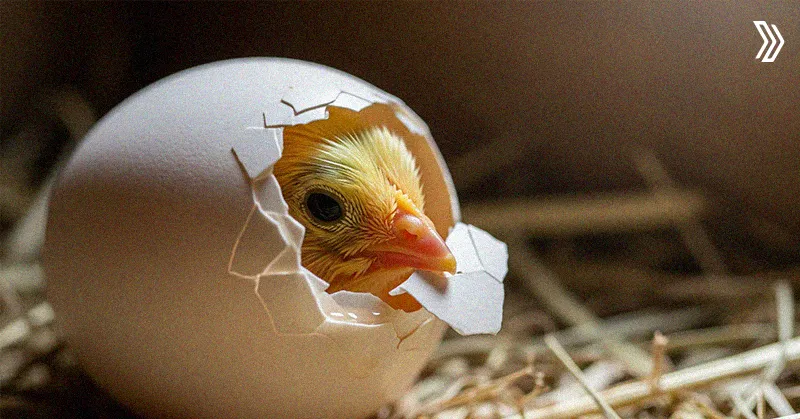
A hatchery is where fertilized hatching eggs transform into viable chicks. But it's really the nerve center of your entire poultry operation—the place where your investment in breeder flocks either pays off or falls flat.
Let's look at this from this angle : every percentage point drop in hatchability directly hits your bottom line. When you're processing thousands of eggs annually, small inefficiencies compound quickly. That's why advanced hatchery management in poultry has evolved from simple egg storage and incubation to a sophisticated, data-driven operation that demands precision at every step.
Getting Your Hatching Eggs Right from the Start
Here's something that most people don't know: the success of your hatchery is already determined before the eggs even arrive. The quality of the hatching eggs is entirely dependent on the breeder farm, but once those eggs are in your hands, time is ticking.
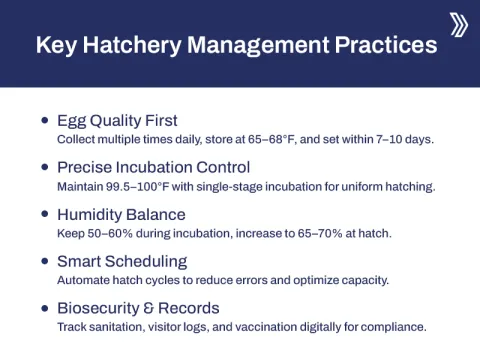
Temperature is important from minute one. Those eggs need to be picked up several times a day and stored at a temperature of 65-68°F.
The question arises but why?
Because the development of the embryo doesn't just begin in the incubator. It begins the moment that egg is laid. Storage time is also important. Beyond seven to ten days, hatchability will be affected. This is where inventory management comes into play—you have to know what you have, when it arrived, and when it needs to be set.
The Science Behind Incubator Temperature Control
Maintaining proper incubator temperature isn't just important—it's everything. We're talking about 99.5-100°F, and that half-degree matters more than you think.
One degree variation can lead to serious issues. If it is running hot, you will end up with early hatchers that are weak and dehydrated. If it is running cold, you will end up with delayed hatches, lack of uniformity, and increased mortality rates. None of these options is good for your business.
Single-stage incubation has revolutionized the industry. Gone are the days when you had to make temperature compromises for different stages of eggs in the incubator. Single-stage incubation allows you to create the perfect conditions for each set of eggs. However, to achieve this, you will need to monitor and adjust the conditions, which is almost impossible without hatchery management software.
Humidity is also dependent on temperature. When incubating, you should maintain 50-60% relative humidity, increasing it to 65-70% during the hatching process. If you get this wrong, you will be able to see the effects in egg weight loss and air cell development
Why Hatcheries Need Digital Solutions
Managing a commercial hatchery with spreadsheets and clipboards?
That's making life unnecessarily difficult. This is where hatchery software comes into play. Modern solutions like Livine's hatchery module have transformed how successful operations run.
How Livine Solves Real Hatchery Challenges?
Livine logs every incoming egg batch with full traceability—breeder flock ID, egg weights, quantities, and source details.
Using barcode scanning and integrated weigh scales, the system tracks each egg's complete lifecycle from arrival through setting, incubation, and hatching. No more guessing which batch came from which breeder farm or when eggs need to be rotated out of inventory.
Environmental Control That Actually Works
The software integrates with advanced AI and IoT sensors to monitor incubator temperature, humidity, and ventilation in real-time. You get instant alerts if anything drifts out of range—when you can actually fix it. This monitoring has saved operations from catastrophic equipment failures.
Smart Hatch Scheduling
Livine's system automates your entire hatch calendar. See weekly and monthly hatch plans at a glance, automatically schedule egg sets and transfers based on the 21-day cycle, and reduce human errors that lead to capacity issues.
Image
Quality Analysis That Drives Improvement
Livine enables detailed breakopen analysis, chick grading, and performance tracking. The system records hatched chicks, grades them based on size and viability, and automatically sorts them into batches for optimal loading. You're building a database that helps you understand what works.
Biosecurity Without the Paperwork
Strict biosecurity is essential, but documentation shouldn't consume your day. Livine is having the advanced technology in the poultry industry that manages sanitation schedules, tracks visitor logs, maintains digital records of fumigation and vaccination, and ensures you're audit-ready without drowning in paperwork.
The Business Benefits You Can Actually Measure
Let's talk ROI. Sun India Hatcheries, a leading Southern India poultry producer with over 25 years of experience, found that comprehensive management software helped them follow best practices daily while providing valuable insights for decisions.
SR's Daily Nutrition in Bangalore saw significant efficiency improvements translating to better yield and profitability. Their Managing Director, Rajesh Reddy, said: "It's not just a tool; it's an essential partner in our journey toward sustainable and data-driven poultry management."
Integration Makes Everything Smoother
Modern hatchery management software connects your hatchery to the rest of your operation. Livine integrates with leading finance ERPs, enables SMS notifications to customers and farm managers, and provides mobile access for monitoring from anywhere.
Your team gets automatic reminders for vaccination schedules. Your transport department receives automated dispatch schedules. Your finance team gets real-time cost analysis without manual compilation. That's operational efficiency that separates struggling hatcheries from profitable ones.
Looking Ahead: What's Next for Hatchery Management
Technology keeps evolving. AI-driven modules analyze historical data to predict optimal incubation profiles. Automation extends beyond monitoring to egg handling, candling, and vaccination.
For operations facing labor challenges, these advances are becoming necessities. Sustainability initiatives like energy-efficient incubators and waste heat recovery cut operational costs while reducing environmental impact.
Hatchery management in poultry is too complex and important to leave to chance. Whether you're running a small specialty operation or managing multiple commercial hatcheries, the fundamentals remain the same—control your environment, track your data, maintain biosecurity, and continuously improve.
Ready to see what modern hatchery management can do for your operation? The technology exists. The question is whether you're ready to use it.
Conclusion
The difference is that today, you don't have to do it all manually. Comprehensive hatchery management software like Livine provides tools to optimize every step, from egg receipt to chick dispatch. The platform gives you complete visibility, helps maintain consistent quality, and provides data for informed decisions.
For poultry businesses serious about competing today, investing in proper hatchery management practices and supporting technology isn't optional—it's essential. The operations that thrive recognize this reality and act on it.

Related Blogs