In today's poultry business, where there is cutthroat competition, yield maximization is not just growing birds but making each step of the production process more efficient. While yield monitoring has revolutionized traditional crop cultivation, application in poultry farming is the next leap forward in precision agriculture. This in-depth blog explores how emerging yield monitoring technology is transforming poultry production from an art to a science.
Comprehending Yield Monitoring in the Case of Chicken
Yield monitoring in agriculture has long centered on crop production, analyzing such things as bushels per acre and examining spatial variability within fields.
But the poultry sector has taken these fundamental concepts and used them to develop highly specialized monitoring systems that consider all factors influencing the production of meat and eggs.
Poultry yield monitoring includes:
- Feed conversion ratio
- Growth rate optimization
- Mortality monitoring and assessment
- Processing plant yield improvements
- Monitoring quality metrics
- Resource use efficiency
In contrast with crop yield monitoring, which is normally seasonally performed, poultry yield monitoring involves continuous measurement of data over several short cycles of production. This continuous data stream facilitates more rapid adjustments and the potential for quick optimization.
Livine's integrated poultry management system is optimum in this real-time monitoring setup with the facilitation of real-time acquisition and analysis of every production parameter. Unlike farm software that is general in nature, Livine was designed specifically to support the special rapid-cycle character of poultry production, thereby enabling producers to make adjustments on the same flock rather than having to wait for the next production cycle.
The Physiology of Modern Poultry Yield Assessment.
The development of yield monitoring in precision agriculture has brought advanced technology into the poultry industry. Advanced monitoring systems in the present era are:
Sensor Networks
Modern poultry housing utilizes networks of sensors that continuously monitor environmental factors affecting yield, such as:
- Temperature and humidity gradients exist throughout the facility.
- Ammonia level and air quality
- Light duration and intensity
- Water usage habits
- Feed line activity.
Each of these parameters directly impacts conversion efficiency and growth rates. By establishing baseline measurements and monitoring deviations, producers can identify yield-limiting factors before they significantly impact production numbers.
Automated Data Acquisition
Manual data gathering brings about human error and delays in yield analysis. Modern yield monitoring technology automatically gathers and wirelessly transmits key production data, such as:
- Weights of birds (flock and individual means)
- Feed intake (total and per-bird)
- Water consumption logs
- Environmental audits
- Death events and reasons
- Activity and behavior patterns
This computerized method maintains data integrity and enables real-time adjustment of yield projection according to existing conditions instead of relying on historical estimates.
Advanced Analytics Platforms
The real value of yield monitoring in farming is not so much in collecting data as it is in sophisticated analysis systems that transform raw figures into actionable information. Sophisticated analytics platforms:
- Find similarities between environmental conditions and yield measurements.
- Estimate the time of peak harvesting from growth curves
- Determine the real-time feed conversion rates.
- Create yield maps showing plant production fluctuations
- Predict production results based on the latest trend
These systems rely on artificial intelligence and machine learning algorithms that keep improving their predictions with each production cycle by learning from it.
Livine's analytics platform offers a distinct advantage through its poultry-specific algorithm, having been trained on millions of data points across different production environments. This focused attention allows Livine to see slight trends that generic agriculture platforms might miss. In addition, the predictive modeling capabilities of the system can predict production results with unparalleled precision, allowing producers to make proactive adjustments instead of having to resort to reactive corrections.
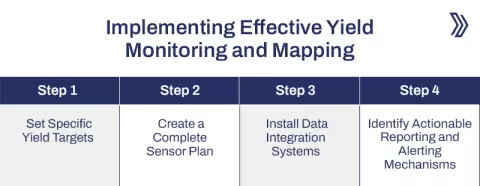
Implementing Effective Yield Monitoring and Mapping
A systematic implementation plan yields the most advantageous outcomes for broiler operations transitioning to comprehensive yield monitoring.
Step 1: Set Specific Yield Targets
Before monitoring technology is installed, determine what "yield" means for your operation. Depending on your production focus, most critical measurements might be:
- For Broiler production: meat yield per square foot, feed conversion ratio, average daily gain
- For Production of layers: eggs/hen housed, cost of feed per dozen eggs, percentage of premium grade eggs
- For breeders: hatchability, chicks per hen, genetic performance tests
These proven measures set definite objectives for your yield monitoring program and provide you with a standard to gauge improvement.
Step 2: Create a Complete Sensor Plan
Successful yield monitoring involves intentional placement of sensors to obtain true, representative data. Consider:
- Environmental sensors of varied height and location within homes
- Water and feed meters for every single section
- Automated weighers for representative sampling installed
- Yield points of the processing line for final product analysis
The goal is to create a thorough understanding of production conditions and results throughout the whole facility, thus removing blind spots that can hide factors that cap yield.
Step 3: Install Data Integration Systems.
Yield monitoring information is more useful when well integrated. Advanced systems ought to:
- Integrate live data with past performance metrics.
- Combine environmental testing with production yields.
- Coordinate changes in feed formulation with yield performance
- Link processing plant yield figures with production figures
- This merging offers a holistic view of the production system and highlights the interplay among input variables and yield responses.
Step 4: Identify Actionable Reporting and Alerting Mechanisms
Action without data gathering accomplishes nothing. A good yield monitoring system needs to have:
- Real-time dashboards with key yield indicators.
- Automatic alerts if the metrics are outside optimal values
- Benchmarking comparative analysis tools for comparison with past flocks
- Scenario modelling ability for testing the possible interventions
- These reporting systems translate raw data into decision support systems to allow ongoing yield improvement.
Livine's alert system incorporates customizable thresholds that can be tailored to each operation's specific targets. The platform's unique intervention tracking feature allows managers to document actions taken in response to alerts and then automatically correlates those interventions with subsequent performance changes. This closed-loop system creates an ever-improving knowledge base of effective management responses to yield-limiting conditions specific to your operation.
Yield Mapping: Mapping Production Variation
One of the strongest uses of yield monitoring for precision agriculture is the creation of yield maps—visual displays of altering production over space and time. This use of yield mapping in poultry production can expose:
- Performance variations among houses or sections of houses
- The effect on production results of equipment variations.
- Ecological hotspots that influence bird performance.
- Feed and water access disparities impact uniformity
By seeing these variations, producers can target interventions exactly where they will have the greatest impact on aggregate production. As an example, finding areas of consistently lower growth might uncover equipment problems or special conditions in the environment that need to be treated differently.
Economic Implications of Precise Yield Measurement.
Integrated yield monitoring installation is a significant investment in management technology and systems. The economic payback always justifies the investment by:
Improved Feed Efficiency
Feed accounts for 65-70% of the cost of production in most poultry operations. Yield monitoring equipment that improves feed conversion by even small percentages is a tremendous cost-saving initiative.
Lower Mortality and Better Health
Early diagnosis of yield-limiting health conditions by monitoring systems lowers mortality rates and the costs of treatment. Operations that employ sophisticated monitoring systems records mortality reduction
Improved Product Quality and Value
Yield is not just about quantity—quality contributes significantly to revenue. Systems that track quality factors affecting meat quality or grade distribution of eggs can enhance the proportion of premium products by a significant amount.
The Future of Yield Monitoring in Poultry Farming
With the development of crop yield monitoring, poultry yield monitoring systems are on the same path toward increased precision and integration. New technologies will have the ability to further transform the way producers monitor and drive production. These developments will make yield monitoring a strategic tool rather than an operational one, enabling producers to verify production processes and results for more discerning consumers.