If you are a poultry owner, you know that collecting eggs is just the beginning. What happens next can make a big difference in how your farm is perceived, how much you earn, and how smoothly your operations run.
Let’s talk about something that often gets overlooked: the importance of sorting and grading eggs.
It might sound like a technical chore, but in reality, it’s one of the most powerful ways to boost your farm’s reputation, reduce waste, and increase profits. And when you pair it with advanced Poultry Management Software, it helps you make more profits
So, What Does Sorting and Grading Really Mean?
In simple terms, sorting and grading eggs is about organizing them based on quality. That includes:
- Size and weight (small, medium, large, extra-large)
- Shell condition (clean, cracked, stained)
- Shape and texture (uniform vs. misshapen)
- Internal quality (checked using candling—think yolk position, air cell size, albumen clarity)
This process helps you decide which eggs go to premium buyers, which are suitable for local markets, and which should be rerouted for processing or discarded.
Why It Matters More Than You Think
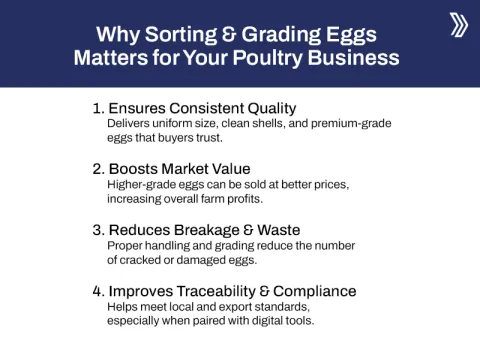
Let’s say you’re selling eggs to a supermarket chain. They expect consistency—same size, clean shells, no surprises. If your eggs don’t meet those standards, you risk losing the contract. Even worse, a few bad eggs slipping through can damage your brand.
On the flip side, when you consistently deliver well-graded eggs, you build trust. Customers know what to expect. Retailers are happy. And you can charge more for higher grades.
Sorting and grading isn’t just about quality—it’s about credibility.
Key Factors to Consider When Sorting and Grading Eggs
If you’re doing this manually, it can be time-consuming and error-prone. But whether you’re using machines or doing it by hand, here are the top things to watch for:
- Cleanliness: Dirty eggs can carry bacteria and are often rejected by buyers.
- Shell strength: Thin or cracked shells break easily during transport.
- Uniformity: Retailers love consistency—it makes packaging easier.
- Internal quality: Candling helps spot blood spots, weak yolks, or watery whites.
And don’t forget environmental factors. Temperature, humidity, and handling methods all affect egg quality. That’s why timing is everything—eggs should be sorted and graded as soon as possible after collection.
How Poultry Management Software Makes It Easier
Poultry management software like Livine ’s is a smart assistant that helps you manage every aspect of your poultry operation, including egg sorting and grading.
With Livine, you can:
- Track egg batches in real time—know which flock produced what, and when.
- Log grading data automatically—size, weight, shell condition, and more.
- Spot trends—see which flocks are producing better eggs, and why.
- Get alerts—if something’s off, you’ll know before it becomes a problem.
Instead of scribbling notes or relying on memory, you get clean dashboards, instant reports, and actionable insights. It’s like having a quality control manager in your pocket.
Let’s say you’re running a mid-sized layer farm, your team sorts eggs manually, records grades in notebooks, and sometimes misses defects. You had occasional complaints from buyers about inconsistent sizes or dirty shells.
But when you use the poultry software tool, you’ve got digital records, automated grading logs, and alerts when a batch doesn’t meet standards. Your rejection rate drops. Your premium egg sales go up. And your team spends less time fixing mistakes and more time scaling the business.
Poultry Eggs: A Product That Deserves Respect
Eggs aren’t just food—they’re a symbol of trust. When someone buys your eggs, they’re trusting that they’re clean, safe, and worth the price. Sorting and grading help you honor that trust.
It also helps you:
Meet export standards
Reduce spoilage and waste
Improve packaging efficiency
Build a brand that stands out
And when you combine that with Livine’s smart tracking and analytics, you’re not just running a farm—you’re running a modern agribusiness.