In the competitive ecosystem of poultry production, growing from one farm to to a multi-site enterprise is part of a significant step toward growth and eventual leadership in the market. For an ambitious poultry business owner, this transition means more than facility expansions; it has everything to do with strong systems that coordinate efforts and maximize resources so profitability is sustained.
Core to this progress is the poultry ERP software strategic tool that transforms fragmented farm data into enterprise-wide intelligence that will enable the owners to attain investment ROI on growth-oriented ventures amidst complex supply chains and regulatory environments.
Business Imperative for Scaling Poultry Operations
Poultry businesses face continuous pressures: fluctuating feed costs, tightening regulations such as FSSAI standards in India, and growing demand from exporters and retailers. While a single-farm model can see a startup through, enterprise success depends on multi-site coordination-managing flocks across locations, standardizing production, and ensuring traceability from hatchery to market. Lacking the right infrastructure, scaling leads to inefficiency: duplicated inventory, inconsistent quality, and compliance risks eroding margins.
Forward-looking owners realize that ERP software for poultry is a necessity, not a luxury. In one place, these platforms compile many critical functions: feed buying, tracking the health of the flock, inventory, and financial reporting.
By implementing poultry management software, companies break down operational silos, saving up to 25 percent from costs through better allocation of resources. This leads to scalable growth in line with revenue targets and long-term investment ROI for growth-oriented owners.
Key Challenges in Multi-Site Poultry Management
Transitioning to enterprise scale introduces its own set of obstacles that can derail even the most promising operations. Inventory discrepancies between sites lead to overstocking or shortages, while manual reporting delays decision-making. Health outbreaks in a single facility cascade because of a lack of real-time visibility, and local regulations vary in their complication for compliance.
Poultry farming software tackles these challenges head-on. Integrated ERP poultry systems include:
- Centralized Inventory Sync: This includes real-time tracking of feed, vaccines, and eggs across farms to avoid wastage and ensure just-in-time replenishment.
- Unified Flock Management: Standardized metrics include FCR-feed conversion rate and mortality rates that facilitate benchmarking to enable owners to replicate top-performing strategies across sites.
- Automated Compliance Reporting: Create audit-ready reports of product traceability for FSSAI, USDA, or export certifications, reducing fines and ensuring entry to premium markets.
These capabilities turn potential liabilities into competitive advantages, making every site a contributor to overall profitability.
Strategic Advantages of Poultry ERP Implementation
The value of poultry software lies in the ability to drive real business outcomes. For example, look at production planning: Advance ERP software for poultry uses predictive analytics to forecast yields based on historical trends, market fluctuations, and site-specific variables. Such precision reduces the risk of overproduction common occurrence in scaled operations-and optimizes cash flow by better aligning output with demand.
Financial oversight also improves dramatically. Poultry ERP consolidates cost data from multiple sites, showing, for instance, highlighting in feed efficiency or labor expenses. The owners receive actionable insights, such as the reallocation of resources from underperforming farms or negotiating bulk supplier deals better informed by enterprise-wide volumes. Case studies from major Indian poultry groups reveal that such systems normally return investment ROI for growth-minded owners within 12–18 months, often accompanied by 15–20 percent margin improvements.
Besides, scalability certainly extends to workforce management. In this respect, mobile-accessible poultry management software means field supervisors log data on the move, while executives access high-level KPIs from any location.
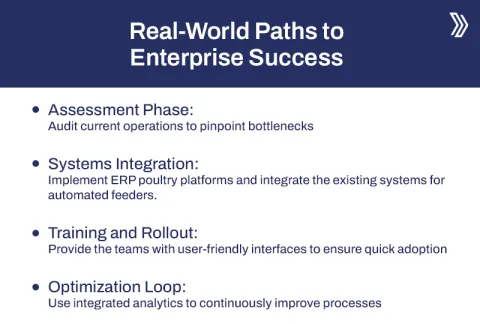
Real-World Paths to Enterprise Success
Successful poultry enterprises follow a structured scaling blueprint, powered by technology:
Organizations that have taken this route, some managing over ten farms, report production capacity doubling without increased overhead, thanks to the discipline brought about by poultry software.
Overcoming Common Scaling Pitfalls. Other obstacles often include resistance to change. Owners used to spreadsheets fear complexity, but modern ERP software for poultry growers emphasizes intuitive design, with role-based access-managers can view operation metrics while executives view financial metrics.
Other concerns include data security. Leading platforms comply with industry standards, safeguarding sensitive business intelligence. Cost is often exaggerated. Initial investments into poultry management software pay off rather quickly through waste reduction and efficiency gains. To the growth-oriented owner, the alternative stagnation in the midst of growing competition is considerably more costly.
How Livine Poultry Software Powers Your Enterprise Journey?
Among other similar solutions, Livine Poultry Software is the only poultry ERP for scaling operations. For the poultry industry, Livine has developed a solution that can integrate all aspects of multi-site management, ranging from the tracking of flocks and optimization of feed to financial forecasting and automation of compliance. Built on cloud architecture, it supports real-time synchronization across farms and offers owners a single window of enterprise oversight.