What Is a Retail PoS System, in Plain Terms?
PoS stands for Point of Sale — it's the software and hardware combination used at the exact moment a customer pays for a product. At its simplest, that's a billing screen, a receipt printer, and a way to record what was sold.
But modern retail PoS software for poultry business use cases goes well beyond billing. A proper system tracks inventory as it moves, updates stock counts the instant a sale happens, generates reports on what's selling and what isn't, and — increasingly — connects the shop counter back to the supply chain that fed it. Think of it as the nervous system of a retail outlet: every transaction sends a signal back to inventory, accounting, and management dashboards, instead of living and dying on a paper slip.
For most retail categories, that's already valuable. For poultry, it's close to essential.
Why Poultry Retail Doesn't Fit a Generic POS Mold
Ask any poultry retailer why they've resisted digitizing their counter, and you'll usually hear some version of the same three problems.
- The product isn't a fixed SKU - it's live weight. A billing system built for packaged retail assumes a barcode and a fixed price. Poultry doesn't work that way. A live bird, a dressed bird, cut portions, or a tray of eggs all sell by weight or count that varies bird to bird, day to day. Your PoS has to handle variable-weight billing natively, not as a workaround.
- Prices move daily — Sometimes hourly. live poultry and egg prices track commodity markets that shift constantly based on regional supply, feed costs, and demand. A retail system that can't update pricing quickly, outlet by outlet, either forces manual overrides at every counter or bleeds margin on outdated rates.
- The product perishes — Fast. Fresh, frozen, cut-up, or ready-to-eat (RTE) poultry products all carry a shelf-life time. Overstocking means wastage; understocking means lost sales and unhappy walk-ins. Inventory visibility isn't a nice-to-have here — it's the difference between a profitable outlet and one quietly leaking money through spoilage.
Layer in the fact that many poultry retailers operate more than one outlet, and often serve institutional buyers (hotels, restaurants, caterers) alongside walk-in customers, and it becomes clear why a poultry business needs retail PoS software built around its specific operating reality — not a general-purpose billing tool retrofitted to fit.
What a Poultry-Specific PoS Actually Needs to Do?
Strip away the marketing language and a genuinely useful poultry PoS system needs to deliver on a handful of fundamentals:
- Fast, accurate variable-weight billing - Supporting live birds, dressed chicken, cut portions, eggs, and processed items, with multiple payment methods so checkout doesn't become a bottleneck during peak hours.
- Real-time inventory tracking - So stock levels for live birds, eggs, and feed update the moment a sale or delivery happens, not at end-of-day reconciliation
- Centralized multi-outlet management — A single view across every store location, so pricing, stock, and performance stay consistent instead of each outlet operating as its own silo.
- Institutional order handling — The ability for regular B2B customers (restaurants, caterers, hotel chains) to place standing or ad-hoc orders, with a clean way to confirm delivery once it's dropped off.
- Reporting that actually answers business questions — Not just "how much did we sell," but sales trends, inventory turnover, and customer buying patterns that feed into restocking and pricing decisions.
- Traceability back to the source - The ability to trace a product on the shelf back to the farm, batch, or processing run it came from, which matters both for food safety compliance and for customer trust.
- Integration with accounting — Because a retail counter that doesn't talk to your books just creates a second reconciliation problem downstream.
None of this is exotic. But it does require software designed with poultry's operating quirks in mind from day one, rather than a horizontal retail tool with poultry features bolted on as an afterthought.
How Livine's Retail PoS Module Fits Into This
This is exactly where Livine's Retail PoS module is built to fit — not as a standalone billing app, but as the retail layer of a poultry business that's already thinking end-to-end, from feed mill to farm to shop counter.
A few specifics worth calling out:
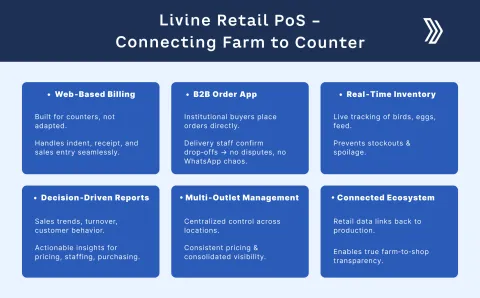
Web-based billing built for the counter, not adapted to it. The system handles material indent, material receipt, and sales entry through a straightforward web interface, so staff aren't wrestling with software that was clearly designed for a different kind of retail.
An app for institutional customers, not just walk-ins. Regular B2B buyers can place orders — create an indent — directly through the application, and delivery staff can confirm drop-off on the same platform. That closes a loop that a lot of poultry retailers currently manage over phone calls and WhatsApp messages, with no paper trail to fall back on when there's a dispute.
Real-time inventory across live birds, eggs, and feed. Instead of a manual stock count at the end of the day, the system reflects live inventory levels continuously — which is what actually prevents the two-sided problem of stockouts on one end and spoilage-driving overstock on the other.
Reports built for decisions, not just record-keeping. Sales trends, inventory turnover, and customer behavior are available as reports management can act on — adjusting purchasing, staffing, or pricing based on what's actually happening at the counter, rather than a gut sense of "we seem to be doing okay."
Multi-outlet by design. For businesses running several retail points, Livine's PoS supports centralized management across locations, which means consistent pricing, consolidated visibility, and one place to look for performance across the whole retail network — instead of piecing together numbers from five different registers.
A connected view, not an isolated one. Because the Retail PoS module sits inside Livine's broader poultry production management ecosystem, a shop-floor sale isn't a data dead-end. It connects back to production and processing data, which is what makes true farm-to-shop traceability possible — a claim that's much harder to make when your retail counter and your production software have never spoken to each other.
A Practical Example
Consider a mid-sized poultry business running four retail outlets across a city, alongside supply agreements with a handful of local restaurants. Without a connected PoS, each outlet manager tracks stock on their own, prices sometimes drift out of sync between locations, and the restaurant orders are managed through phone calls that occasionally get missed or double-booked.
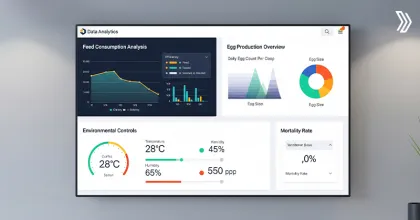
With a system built for this specific setup, the head office gets a single dashboard showing stock and sales across all four outlets in real time. Prices update centrally and reflect everywhere at once. Restaurant partners place orders through the app, delivery is confirmed digitally, and there's now an actual record if a delivery is ever disputed. At month-end, instead of someone manually adding up four separate registers, the reports are already sitting there — broken down by outlet, by product, by customer.
That's not a hypothetical efficiency gain. It's the specific, measurable difference between a poultry retail operation running on habit and one running on visibility.
The Bigger Picture:
Retail Is Part of the Chain, Not the End of It
It's worth stepping back and making one point clearly: for a poultry business, the retail counter isn't a separate function from the farm — it's the last visible link in a much longer chain that includes breeding, hatching, feed, growing, and processing. A retailer who can't see what happened upstream — which batch a bird came from, how it was graded, what the feed conversion looked like — is operating with less information than they actually have available to them.
This is why poultry ERP conversations increasingly treat retail PoS not as an add-on, but as a core module that should be as connected to the rest of the operation as feed mill or hatchery software already is. If you're evaluating whether your retail operations are pulling their weight versus quietly bleeding margin through wastage, price mismatches, or disconnected record-keeping, that's usually the first sign it's time to look at dedicated software rather than another spreadsheet fix.
If you're running poultry retail outlets and still reconciling registers by hand at the end of the day, it might be worth seeing what a connected system looks like in practice
Connect with us to discover how Livine Poultry ERP can streamline your operations and secure your growth