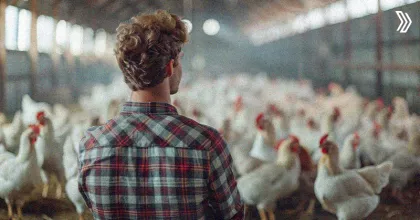
Expanding a poultry business without a strong operational foundation often leads to inefficiencies, rising costs, and disconnected data. This blog explores why leading global poultry companies invest in Poultry ERP before expanding their operations. By centralizing data, improving real-time visibility, standardizing processes, and providing greater control over costs and production, ERP helps businesses make informed decisions and reduce operational risks
Published 12 Jul 2026
Why Global Poultry Companies Are Investing in ERP Before Expanding
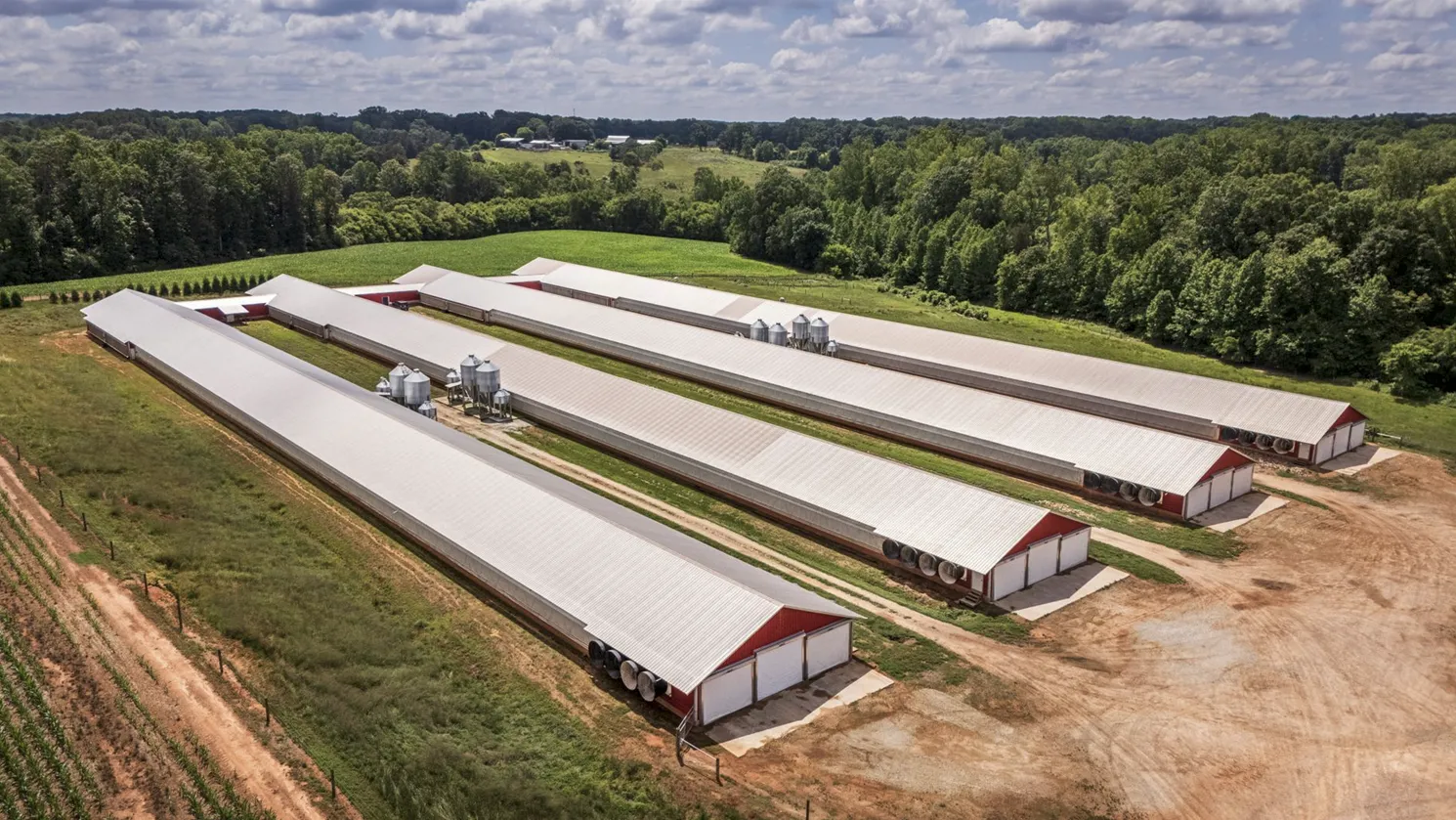
There's a pattern that shows up again and again among the poultry companies that successfully scale across regions, countries, and continents — they don't expand first and fix operations later. They get their operations right before they grow.
That sounds obvious on paper. But in practice, most poultry businesses do the opposite. They open a second farm, bring on a new hatchery, or launch a retail line — and only then realize that their existing systems weren't built to handle the complexity that comes with it. Suddenly, data from three locations doesn't talk to each other. Feed costs are being tracked in different spreadsheets. Production numbers don't match the finance team's numbers. And someone, somewhere, is working off outdated information.
This is exactly why enterprise resource planning — ERP — has become the first investment serious poultry businesses make before they expand. Not the last.
Expansion Breaks What's Already Fragile
Here's the thing about growth in the poultry industry — it amplifies everything. If your data management is slightly off at one farm, it becomes a serious problem at five. If your feed cost tracking has gaps, those gaps multiply when you're running a feed mill that supplies three broiler units. Margin errors that were manageable at small scale become financially dangerous at large scale.
What global poultry companies have learned — often the hard way — is that expansion doesn't create new operational problems. It exposes the ones that already existed. ERP implementation before expansion is, fundamentally, a risk management decision.
When a business has a centralised system managing everything from flock records and feed consumption to hatchery performance and processing output, they're not just more organised. They're more resilient. A disease alert at one farm doesn't get buried in an email chain. A sudden spike in mortality rate at a breeder unit shows up in a dashboard the same day, not a week later when someone updates the spreadsheet.
The Real Business Case for Poultry ERP
When owners and managers of poultry companies talk about what ERP actually delivers, the conversation usually comes down to three things: visibility, speed, and control.
1. Visibility
Multi-site poultry operations are notoriously difficult to manage without real-time data. When a farm manager in one location is making feeding decisions without knowing what the rest of the supply chain looks like, you end up with inefficiencies that quietly eat into margin. ERP brings all of that — production numbers, flock health data, feed usage, hatchery output — into a single view.
2. Speed
In an industry where a two-day lag in identifying a health issue can wipe out a significant portion of a batch, speed of information matters enormously. ERP systems that capture data at the farm level and surface it instantly to management aren't a luxury — they're a competitive necessity.
3. Control
Expanding into new geographies, new segments, or new verticals requires a level of operational control that manual processes simply can't deliver at scale. ERP gives businesses the ability to standardise processes across sites, enforce feed formulations, track costs to the batch level, and actually understand which parts of the operation are profitable and which aren't.
What Smart Expansion Actually Looks Like
The companies that scale successfully in the poultry industry tend to follow a similar playbook. Before adding capacity, they invest in understanding exactly where their current capacity is being underutilised. Before entering a new market, they build the infrastructure to track performance in that market from day one.
That infrastructure is ERP. And increasingly, it's poultry-specific ERP — not a generic enterprise system that's been adapted for agriculture, but software built from the ground up around the specific workflows of a poultry business: flock cycles, feed conversion ratios, hatchery setters and hatchers, breeder flock management, layer production targets, and processing plant yields.
Image
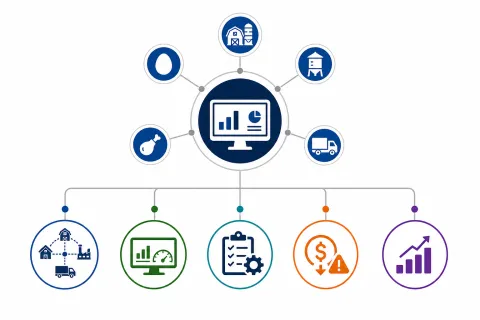
The difference matters. A generic ERP can track inventory and financials. A poultry-specific ERP can tell you that your feed conversion ratio at Farm 3 has been trending upward for the last two cycles, that it correlates with a change in feed supplier, and that if the trend continues, it will push that farm below your target margin for the quarter. That's a different class of insight.
How Livine Is Changing the Equation?
This is where Livine enters the picture — and why it's gaining traction with poultry businesses across South Asia, the Middle East, and beyond.
Livine is built specifically for the poultry industry, covering the full operational chain — breeder farms, broiler farms, hatcheries, feed mills, layer operations, and processing plants, all the way through to retail point-of-sale. That end-to-end coverage is not common. Most software solutions handle one or two parts of the chain well and require stitching together other tools for the rest. Livine brings it under one roof.
What's particularly important to note is Livine's Production Planning module. For businesses preparing to expand, production planning is often the first thing that breaks. Forecasting demand, estimating costs, planning flock placements, identifying break-even points across multiple sites — these are complex, interconnected decisions. Livine's AI-powered planner brings structured precision to these decisions in a way that spreadsheets and instinct simply can't match.
And there's a practical angle here too. Livine's poultry cloud-based architecture means that businesses expanding into new regions don't need to worry about IT infrastructure at every new site. Farm managers can update data from the field. Executives can pull reports from any device, in any location. The system also supports multiple languages, which matters more than it might seem when you're managing operations across different countries with different teams.
That's the shift Livine represents: from poultry software as an administrative tool to poultry software as a business intelligence platform.
The Timing Question: Why ERP Before Expansion?
Businesses often ask whether they should implement ERP now or wait until they're bigger. It's the wrong question. The right question is: what are you flying blind on today, and how much bigger will those blind spots get when you add another farm, another market, or another product line?
Implementing ERP during expansion is significantly harder than doing it before. Teams are stretched, attention is split, and there's no clean baseline to work from. Companies that get the system in place first — and actually use it to generate reliable data across at least a few production cycles — enter expansion with something genuinely valuable: operational clarity.
They know their real cost per kg. They know which flocks consistently perform and which don't. They know where feed wastage is happening. They know what their hatchery yield looks like across seasons. That knowledge doesn't just help them manage existing operations — it tells them where, when, and how to expand.
If you're planning to grow your poultry business, the question isn't whether you'll need an ERP. It's whether you'll have one ready before growth makes the absence of it expensive.
Conclusion
Global poultry companies aren't investing in ERP because they've reached some threshold of size where it becomes necessary. They're investing in it because they understand that sustainable growth in a margin-sensitive industry requires operational discipline — and operational discipline at scale requires the right systems.
The businesses that will lead the poultry industry over the next decade aren't necessarily the ones with the most land or the most birds. They're the ones with the clearest picture of what's happening across their operations — and the tools to act on that picture faster than anyone else.

Related Blogs