Every successful poultry farm owner knows that the first two months of a chick's life are what break or make an entire production cycle, and such a critical period is dependent on one easy habit that decides whether your flock thrives or merely exists. When we talk about brooding in poultry, we're not just talking about keeping baby chicks warm – we're considering the starting point of poultry production that directly influences mortality rates, growth performance, feed conversion ratios, and your bottom line.
What is Brooding in Poultry?
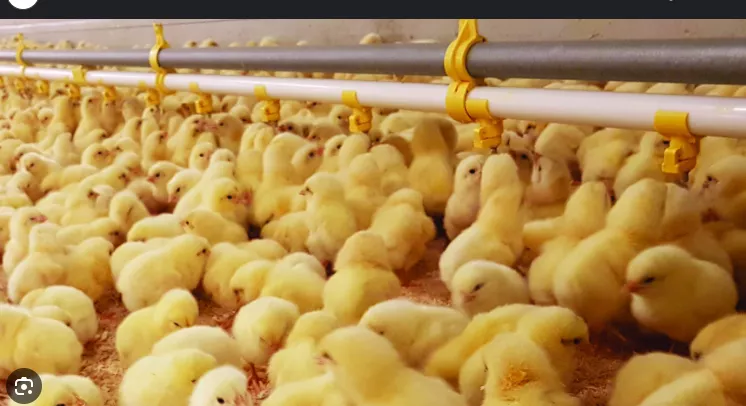
Brooding in poultry is the provision of newly hatched chicks with the optimal environmental conditions during their initial stage of growth, typically over the first three to six weeks of life when the vulnerable birds cannot efficiently control their own body temperature. Throughout this critical phase, chicks must have precisely controlled temperature, humidity, ventilation, lighting, and access to good feed and water to develop robust immune systems and grow into healthy, productive birds. But what separates fine brooding practices from bad brooding practices is not just know-how – it's having the ability to monitor, adjust, and respond to changing conditions in real-time, something that manual procedures simply can't do to the required degree of precision demanded by modern commercial production.
The Importance of Brooding to Poultry Operations
The importance of brooding in chickens cannot be overstated because this stage dictates the course of the balance of the production period, and mistakes started here can result in problems that persist throughout the life of the bird, affecting everything from uniformity and feed conversion to resistance to disease and final market weight.
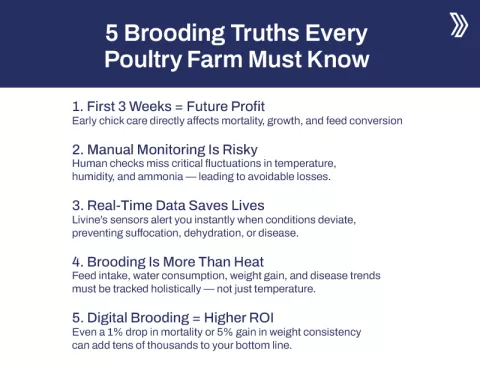
Research consistently shows chicks experience in suboptimal brooding conditions to be growth-stunted, weakened immune responses, and with increased mortality, as well as negative feed conversion ratios that can cost producers thousands of dollars per flock. If temperature fluctuation goes undetected for some hours, chicks will bunch together and suffocate or scatter out too much and freeze – both of which reduce welfare and performance.
The Cost of Poor Brooding Management
Similarly, humidity levels that deviate from ideal levels cause dehydration or respiratory disease, and poor ventilation creates ammonia concentration that compromises developing respiratory systems and creates the ideal environment for disease to develop.
On commercial farms, improvement in every percentage point in brooding mortality directly impacts the profitability of the entire flock, and the compounding effect of enhanced weight gains, feed conversion, and uniformity during brooding multiply right through the entire production system.
Traditional Brooding Management in Poultry: Limitations
Traditional brooding management in poultry has largely relied on human observation, where farm personnel carry out random checks twenty-four hours a day to assess chick activity, relocate heaters, and maintain environmental conditions that remain within acceptable ranges. Even dedicated farm laborers will surely do their best, but this approach has limitations built into it – human beings need sleep, can only be in one place at a time, and use subjective judgment to make key decisions instead of precise information.
The Human Factor in Manual Monitoring
A worker might check the brooding house at 10 PM and everything is okay, but at 2 AM, a failure of a heater can cause temperatures to fall ,harming the chicks, which will be known the next early morning.
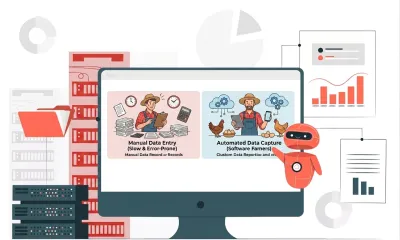
Even in the day, laboriously recording temperatures, humidity, and other parameters in logbooks provides the opportunity for human error, makes it difficult to read trends, and provides no early warning system for anything amiss except outside of standard check times.
How New Generation Poultry Management Software Transforms Brooding
It is precisely where new generation poultry management software transforms brooding from a labor-intensive guessing game into a data-driven, highly optimized procedure that maximizes chick survival and performance at lower labor cost and stress to farm workers.
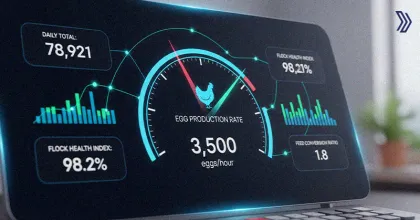
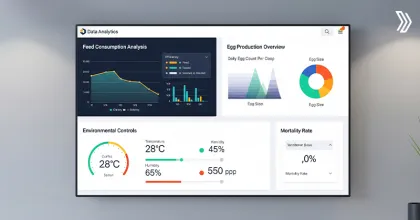
Livine software allows farm owners to see all key parameters in their brood houses 24/7 via connected sensors that continuously monitor temperature, humidity, ammonia levels, and other environmental conditions, all sending real-time data to central dashboards accessible from smartphones, tablets, or computers anywhere.
When conditions deviate from pre-set optimal levels, the system is set to inform farm managers immediately via multiple channels – push notifications, SMS, or email – with issues identified and fixed within minutes, not hours, significantly reducing the risk of catastrophic losses that can be incurred in those precious first few weeks. Such urgency is just impossible with antiquated manual monitoring, no matter how hard your people might work.
Holistic Data Monitoring Beyond Temperature
The worth of brooding in chickens extends far beyond simple observation of environmental factors, such as detailed management of feed consumption, water intake, weight gains monitoring, and disease surveillance all working together to form a comprehensive image of flock performance during this very important period. Modern poultry software allows farm managers to record and monitor all of these parameters systematically, picking up on trends and patterns that would be impossible through manual recording alone.
Data-Driven Decision Making in Brooding Management
Understanding what is brooding in poultry from a modern business perspective is recognizing that this phase generates vast quantities of useful information that, if recorded and interpreted properly, provides insights for continuous improvement across a number of production cycles. Every flock has lessons to teach, and sophisticated poultry management software enables farm owners to contrast brooding parameters among various batches, seasons, and brooding houses and determine best practices and streamline protocols rationally.
Learning from Every Flock
Perhaps a certain temperature pattern always produces better weight gain with fewer losses, or perhaps a certain ventilation regimen reduces respiratory issues without detracting from thermal comfort – all of this can only be achieved when observations from more than one flock can be compared and examined objectively, which paper records and manual monitoring make very difficult for anybody but the largest operations with professional data people.
Documentation for Compliance and Audits
This end-to-end activity tracking not only helps identify where additional training might be required but also creates records that are invaluable when analyzing performance issues, responding to regulatory inquiries, or demonstrating conformity to customer audit requirements and animal care procedures. The interpretation of brooding poultry extends into the realm of biosecurity and disease control, wherein electronic management systems have a great deal to provide over traditional paper-based systems.
The Economic Impacts of Enhanced Brooding in Poultry
The financial implications of successful brooding in chickens are considerable, with studies indicating that every percentage point improvement in brooding mortality directly impacts overall flock profitability. For a large-scale enterprise with multiple flocks annually across several houses, tiny improvements in brooding performance – perhaps reduced first-week mortality from 3% to 2%, or improved day-21 weight consistency by 5% – can contribute tens of thousands of dollars to annual profit.
ROI on Poultry Management Software
Poultry management software enables realization of such gains not in the form of breakthrough changes, but through systematic implementation of best practices, early-stage detection of issues, and data-driven decision-making free from the inconsistency of manual-only systems. The return on investment is realized shortly – within weeks rather than months or years – and thus brooding presents the best starting point for digitalization of poultry operations.
Why Livine is your best choice for Brooding Operations
Most contemporary poultry farm owners realize now that the importance of brooding in poultry is not just the first few weeks in isolation, but setting up the foundation for the entire value chain from hatchery to processing plant. To get repeatedly superior brooding outcomes requires systems that eliminate human error, allow constant monitoring, and transform raw data into action-able intelligence.
Purpose-Built for Poultry Operation
Livine has been specifically designed with the operational needs of poultry operations in mind, offering intuitive interfaces that farm staff can master easily, robust sensor integration that holds up to the harsh conditions of poultry houses, and full analytics that turn data into action without requiring advanced technical expertise or separate data science personnel. The system allows farm managers to track more birds with greater precision than ever before possible, brooding now being a competitive edge, not a risk factor.
The Future of Brooding: Digital Transformation Begins Here
As the poultry industry continues to evolve towards increasing integration, increasing production levels, and increasing performance demands, successful farms will be those which embrace technology not in substitution for good stockmanship but as a tool which complements the skills of good farm managers.
Chick brooding is the perfect location to start this digital revolution since the advantages can be realized in a matter of months and since creating good data collection and management habits during brooding simply translates to all other phases of production.