Carbon‑neutral poultry farming is redefining agribusiness, blending sustainability with profitability. Consumers demand eco‑friendly poultry products, while global regulations and ESG investors reward farms cutting emissions. Strategies like renewable energy, smart feed sourcing, waste‑to‑fertilizer innovations, and IoT monitoring reduce costs and boost margins. Livine’s Poultry ERP simplifies carbon tracking, waste management, and reporting, helping poultry businesses achieve sustainability goals, secure premium markets, and thrive in the future of green poultry farming.
Published 31 May 2026
Carbon-Neutral Poultry Farming: A Smarter Path to Profitability
If you walk into any supermarket today, you will witness an interesting phenomenon: consumers are no longer exclusively concerned with the prices marked on the products. They are reading the labels, and the terms they are interested in finding are “organic,” “sustainable,” and “carbon neutral.”
For the poultry industry, this is not merely a trend; it is a paradigm shift that is transforming the industry as a whole. From being about the optimization of feed conversion ratios, low death rates, and the optimization of the production cycle, the industry is now being about being “carbon efficient.”
Producers that can genuinely demonstrate reductions in carbon footprint and being green in the way they operate not only the planet but also the premium markets and the confidence of the investor community.
What Carbon-Neutral Poultry Farming Means?
Essentially speaking, the concept of carbon-neutral poultry farming is about equilibrium. In other words, everything generates greenhouse gases—whether it is the production of the feed used to grow the poultry, the electricity used to power the shed, the manure management system, or the transportation of the poultry to the market. In order to become carbon neutral, there is a significant reduction in greenhouse gases that needs to be achieved and then the offset of the remaining greenhouse gases through means such as renewable energy projects or carbon credits.
Think about it: the concept of sustainability is no longer viewed as a "cost center." It is now a means of profitability. It is measured and optimized in terms of every kilowatt hour of electricity used, every pound of feed used, and every mile driven. It is a "whole" approach to poultry farming in that the environmental impact is directly related to the bottom line. There is no longer any "speculation" involved—only data as the means of guidance.
This concept has gained massive traction lately. With global regulations tightening and consumer preferences evolving, poultry businesses ignoring it risk getting left behind. But those who lean in? They position themselves as leaders in what's fast becoming the new normal for sustainable poultry farming, eco-friendly poultry businesses, and green poultry operations.
Why Poultry Businesses Can't Ignore It?
From a business perspective, becoming carbon neutral is a powerful strategy with real benefits.
First of all, consumers are voting with their wallets by paying more money for products with carbon-neutral certifications (about 20-30% more for poultry products). In a market flooded with chicken as a commodity, you set yourself apart with this certification, thus making everyday consumers into loyal supporters who view you as someone progressive and responsible.
Next, the export opportunities. The European Union and North America (both big players) are currently increasing sustainability requirements. For example, Europe has established its Green Deal, requiring carbon footprint reporting on any imported goods; therefore, if your farm cannot meet these standards, you may very well be subject to tariff(s) or denied admission altogether—so get ahead of the game and be export-ready to access substantial markets that place a premium on green attributes.
Next the investors. ESG funds (Environmental, Social and Governance) are investing billions into agribusinesses that meet Net Zero goals. A farm with solid carbon data is not only attractive, but it also has the potential to receive investments. There are examples where the use of sustainability measures have resulted in getting funding in rounds that would not otherwise be available using only traditional measures alone.
And here's the cherry on top: costs can actually drop. Smarter feed strategies reduce waste, renewables slash energy bills over time, and waste innovations create new revenue streams. It's not sacrifice; it's optimization.
Practical Steps to Achieve Carbon Neutrality
Here are the practical steps that poultry farms can adopt for achieving the carbon neutrality:
- Recheck Your Feed Strategy
Feed accounts for up to 70% of a poultry farm's emissions, the main contributing factor is the grain production. Start by sourcing locally to cut transport emissions—partner with regional suppliers for fresher, lower-carbon inputs. Experiment with alternatives like insect meal or algae-based proteins, which have a fraction of the footprint of traditional soy. Use data analytics to optimize and track conversion ratios in real-time and adjust based on bird performance. Farms doing this report 15% emission reductions without sacrificing growth rates.
Go with Renewable Energy
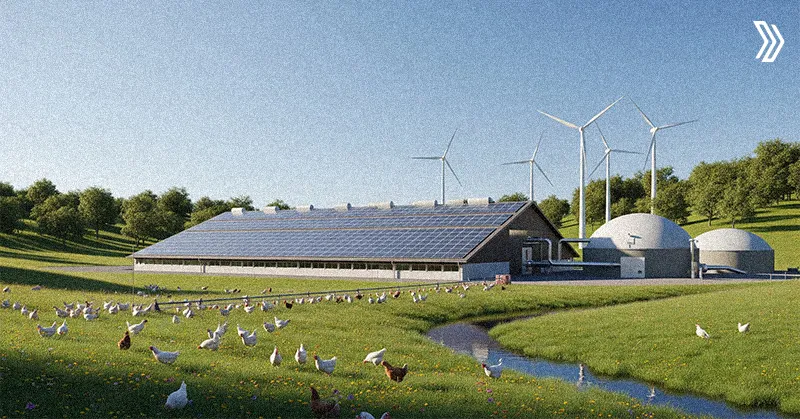
Don't use fossil fuels and replace it with what's reliable and increasingly affordable. Install solar panels on shed roofs—they're dropping in price and can cover daytime power needs entirely. For manure-heavy operations, biogas digesters turn waste into methane for on-site energy, powering everything from ventilation to lighting. Even small wind turbines work in windy regions. The payback? Often under 5 years, with zero fuel costs thereafter.
Image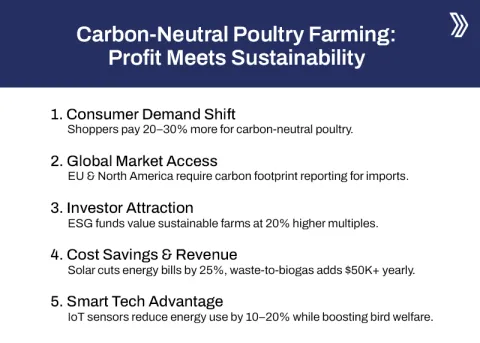
- Transform Waste into Wealth
Manure is the main source of methane gas emissions in poultry farming; however, it does not have to be that way. The aerobic composting method and anaerobic digestion can turn manure into valuable organic fertilizer that can be sold as a byproduct or used as fertilizer on the farm. The biogas plant can be used to utilize the methane gas, which is dual-purpose waste management. This method can cut methane gas emissions by as much as 50%.
- Deploy Smart Monitoring Technology
Advanced technologies like the IoT sensors are game-changers. These measures can be implemented and monitored in real time in terms of water usage, ventilation rates, temperature, and lighting. Rather than keeping the systems on all the time, automation based on necessity can be implemented. This includes the use of fans when the humidity is up and the lighting being reduced when natural light is available. This precision results in a 10-20% saving in energy consumption and improves bird welfare and yields.
Offset Inevitable Emissions
You can't eliminate everything, so offset smartly. Purchase certified carbon credits from reforestation or renewable projects, ensuring they're verified by standards. Many farms add this with on-farm tree planting, boosting biodiversity and creating microclimates that benefit operations.
Implement these in phases: Start with low-hanging fruit like feed tweaks and sensors, then scale to renewables. Track progress with simple dashboards to stay motivated.
The Numbers That Make the Business Case
Let's talk ROI.
A typical mid-sized poultry farm emitting 5,000 tons of CO2e annually can cut that by 40-60% within 2-3 years.
- Energy costs?
Down 25% via solar and efficiency.
- Waste revenue?
Add $50,000+ yearly from biogas or fertilizer.
- Premium pricing?
Lifts margins by 15%, and export deals can double revenue streams. Investors often value ESG-compliant farms at 20% higher multiples. It's not theory—it's math that can be obtained.
How Livine Makes It Effortless?
Livine has an all-encompassing package for carbon-neutral operations, eliminating the need for a lone endeavor. The Poultry ERP system tracks feed efficiency, makes environmentally friendly substitutions, and reduces waste to achieve instant cuts in emissions. It also includes Internet of Things functionality in managing energy and water usage, spotting any leakage or excess usage as a justification for environmentally friendly upgrades.
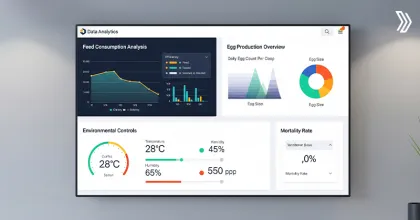
In the management of waste, the poultry management software tracks the amounts of manure and the generated biogas. However, its greatest strength is in the generation of carbon footprint reports. It aggregates information from feeds, energy sources, logistics, and other relevant fields through its dashboard. It also allows the organization to measure its performance based on global benchmarks, ready for the day when they start exporting.
Livine helps in simplifying the most complex data into an easily understandable format that allows the organization to make strategic decisions based on facts/data rather than guesswork.
Sustainability isn’t a cost, it’s your competitive edge. Go green, grow margins—connect today!
Conclusion
Carbon-neutral poultry farming is no longer a luxury but a necessity for the future. By redefining feed, harnessing renewable energy, reusing waste, and harnessing technology like Livine, it is possible to reduce costs and increase growth. The message for entrepreneurs and business owners is to adopt green practices to sustain their competitive edge in the market. Going green and making money are no longer mutually exclusive.

Related Blogs