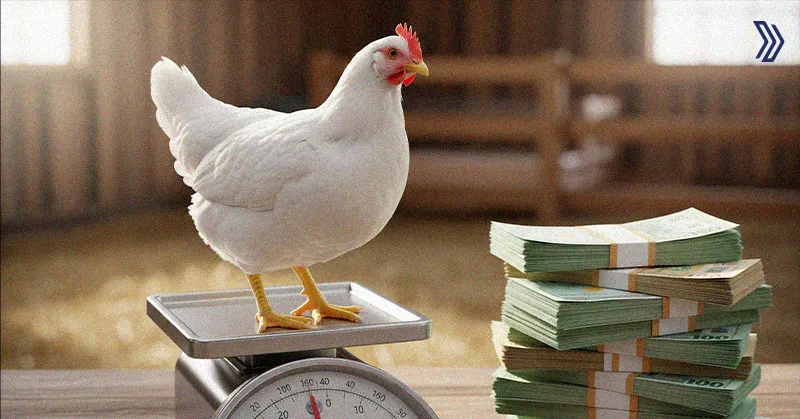
In the poultry business, every owner sees the rate per kilogram. Farmers, traders, and wholesalers negotiate fiercely for a little difference in price.
But in fact, the real issue often is in a place that is most overlooked at—grams, not kilograms.
Losing just 15-20 grams per bird may sound of little value only, but in large‑scale business, these small grams silently and gradually erode all margins and can turn profitable deals into losses.
This blog uncovers the hidden economics behind small weight discrepancies, why they matter, and how poultry businesses can plug this profit leak.
Why 15–20 Grams Looks Small but Isn’t?
At first glance, 15–20 grams seems negligible.The weight of a broiler ranges between 1.8 and 2.5 kilograms. Thus, a loss of a few grams can be considered insignificant.
But poultry trading is a volume business.
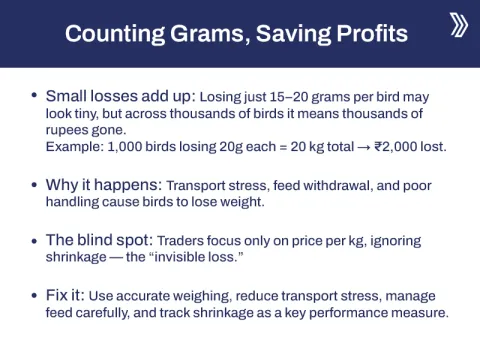
- Per Bird Impact: A loss of 20 grams in a 2-kilogram bird is a loss of 1% of the weight.
- Per 1,000 Birds: This translates into a loss of 20 kilograms.
- At ₹150 per kilogram: The loss of opportunity is ₹2,000 in 'invisible margin.'
Now, take into account the situation where 15,000 birds are being traded on a weekly basis. This translates into a loss of ₹20,000—not because of unfavorable trade, but because of the grams that are not seen.
The Science of Shrinkage
There can be a lot of factors that can impact the Weight loss in poultry
- Transport Stress: Whenever there is a long journey the birds lose moisture and body weight.
- Feed Withdrawal: To reduce contamination, feed is withheld before transport, leading to shrinkage.
- Handling & Holding: Poor handling or extended holding times before sale increase weight loss.
Each gram lost is a gram unpaid. Traders who ignore shrinkage essentially donate their margins to inefficiency.
Why Traders Focus on Rate, Not Grams?
The psychology of trading explains this blind spot:
- Visible vs. Invisible Loss: A ₹2 difference in rate is visible on paper. A 15‑gram shrinkage per bird is invisible until calculated.
- Negotiation Culture: Poultry business currently deals are struck on per‑kg rates, not per‑bird weight accuracy.
- Market Habit: Everyone talks in rupees per kg, and ignores the grams so grams rarely enter the conversation.
This cultural blind spot is why many traders celebrate winning a better rate while unknowingly losing more in shrinkage.
Case Study: The ₹2 vs. 15 Grams Dilemma
Imagine two traders:
- Trader A negotiates ₹2 better per kg but ignores 15 grams shrinkage per bird.
- Trader B accepts the market rate but manages shrinkage carefully.
At 1,000 birds, Trader A saves ₹4,000 on rate but loses ₹1,500 in shrinkage. Trader B loses nothing to shrinkage. The net margin difference? Trader B actually comes out ahead.
This illustrates the uncomfortable truth: grams decide profit more often than rate differences.
The Economics of Precision
Poultry farming profit per chicken is already a tight calculation. Feed, medicine, labor, and mortality eat into margins. When shrinkage adds another hidden cost, profitability suffers further.
- Feed Efficiency: Every gram lost is feed wasted.
- Market Timing: Selling birds at optimal weight reduces shrinkage risk.
- Customer Trust: Consistent weight delivery builds reputation and repeat business.
Hidden Profit Leak in Numbers
Let’s break down the math for clarity:
Even conservative estimates show lakhs of rupees lost annually due to ignored grams.
How to Plug the Leak
1. Weigh Birds Accurately
Invest in precise digital weighing systems. Manual or outdated scales often under‑report weight.
2. Optimize Transport
Reduce travel time, improve ventilation, and minimize stress. Less stress equals less shrinkage.
3. Feed Management
Balance feed withdrawal with shrinkage control. Over‑withholding increases losses.
4. Cold Chain & Holding Practices
Maintain proper holding conditions to prevent dehydration.
5. Data Tracking
Monitor average shrinkage per batch. Treat grams as a KPI, not a rounding error.
The Bigger Picture: Poultry as a Precision Business
The poultry industry is gradually shifting towards precision agriculture. This is because the industry is increasingly measuring not only the conventional parameters such as feed conversion ratio and mortality rate but also shrinkage, treating it as a parameter of equal importance.
In this way, every gram that is lost counts, and this is similar to the way one would measure the leakage in a water tank. The bigger picture that emerges by taking into account the parameter of shrinkage is that the industry gets a clearer picture. You may not see it immediately, but over time, it empties your profits.